Issue #143 - Engin Kurutepe
Happy Monday, everyone!
We made it to Issue #143! Thank you to everyone who read last week’s issue ❤️
Today is the day! This issue (if you are reading via email) is being sent by Substack… I really hope this made it to all of your inboxes 🤞
If you want to read in the Substack app or follow along there too, here’s the link:
But besides that, I want to say that it feels soooooo good to be bringing Indie Dev Monday back! A good amount of you have reached out to me to let me know the joy these issues have been bringing you 🥹 It’s also been bringing me joy as well! I look forward to Mondays and finding new indies to interview. It’s also reignited my spark for indie dev projects so… stay tuned for those 😉
Anyway… it’s time for this week’s indie and it’s another good one! 👇

Today’s Spotlighted Indie Devs
📆 Today I’m featuring Engin Kurutepe.
Engin has been in the iOS game since the very beginning and SolarWatch has grown into something really special with over 500,000 downloads. I’m excited to learn more about his journey and what’s next. Check out SolarWatch and XCBabel and give Engin a follow! 😊
👉 Please make sure to follow them or support them anyway you can! 😇 I’m excited to share their indie dev stories.
Indie Dev

Engin Kurutepe
Q&A
1) What is your name? Where do you live (city or general area)?
My name is Engin (g like GIF). I was born and raised in Istanbul, Turkey, and I’ve been living in Berlin for almost 20 years.
2) Introduce yourself. Education? Background? Main job? Interests outside of tech? Interests inside of tech?
I studied electrical engineering in Istanbul and came to Berlin for a PhD on multi-camera video compression and streaming. I was deep into MPEG and H.264/265. Then the iPhone happened. I couldn’t afford one as a broke PhD student, but when the App Store was announced I thought, I’m already writing code all day anyway, how hard can learning Objective-C be? Turns out there’s a big difference between breaking your own research code and breaking code for thousands of users.
Long story short, I never finished the PhD. I worked various iOS jobs, did a lot of contracting, co-founded a company, built a few apps of my own, and now I’m a product manager at RevenueCat. Outside tech, aviation is my thing. I’ve been flying gliders since 2013 and I’m working toward my single-engine license. My eventual goal is a commercial license so I can fly professionally on the side.
3) Have you ever considered yourself an indie developer?
Yes. Absolutely. I’m an indie dev by passion. Since my PhD days, that direct feedback loop from users, the good, the bad, the “why is this broken?”, has been addictive. Building something people enjoy and voluntarily pay for is a joy that never gets old.
4) What got you started/interested in creating your own applications outside of your “normal” job?
At the time I was building the Berlin office for Keepsafe. The CEO told me, “If I see you commit code on Github, you’re fired.” So I did the logical thing and wrote code on evenings and weekends instead. That’s how my indie projects were born.
5) How do you balance your time between friends/family, work, hobbies, and indie dev?
Poorly. The only strategy that works for me is being very clear about priorities and aggressively ignoring everything else.
6) SolarWatch - The golden hour is sacred to photographers. Is this what sparked your interest in creating SolarWatch? If so, do you have any pictures you’ve captured with the help of SolarWatch or do you have any that your users have captured?
SolarWatch wasn’t solving a problem so much as ambushing me. I was on the couch watching TV with my wife when the idea for the SolarWheel visualization hit me. I grabbed my laptop and started building immediately. The first version had a much more instrument-like aesthetic. I shared an early prototype on Twitter and the one and only Matt Davey came back with the color palette that defines the app today.
7) SolarWatch - SolarWatch has over 500,000 downloads. That’s a lot of people watching the sun! What do most people use SolarWatch for? What’s the most unexpected way you’ve heard someone using the app?
Everything from planning photo shoots to staying in sync with daylight to checking whether their future home gets enough sun. SolarWatch went from a tiny side project to a widely used app after Apple featured the SolarWatch Widgets during the iOS 14 release when the Widgets were introduced.
8) SolarWatch - Map mode and AR mode feels like magic when you’re scouting a location. But behind magic is usually some crazy technical challenges. Were these planned in your initial idea for SolarWatch? And was there a moment where you thought “this might be impossible” before you got it working?
Not planned at all. SolarWatch started in 2017 as a small utility and grew feature by feature. AR mode was particularly tough because ARKit wasn’t designed to render objects at infinite distance. It has a hard cutoff, so getting the sun projection to feel correct while pretending it’s infinitely far away required some creative math.
And even without AR, time, date, and time zones are notoriously unintuitive. I usually tinker at the edges and improve what’s already there, and every once in a while the suns align and I ship a bigger feature. I have plenty more ideas… and very little time.
9) SolarWatch - Sun tracking seems simple on the surface, but I imagine there’s wild complexity underneath (time zones, daylight saving, regions where the sun doesn’t rise or set for months). What are some of crazies edge cases you’ve had to cover? How do you test them and do you think you’ve covered them all?
The fun bugs come from “almost right” date and time logic. Someone from an edge-case location will email me a wonderfully specific bug report, and I love them for it. Recently, someone north of the Arctic Circle reported that during the winter when the sun never rises, the twilight labels were correct but the SolarWheel rendering froze on the first day without sunrise.
Luckily the iOS simulator lets me pretend to be anywhere on Earth.
For real-world testing, I once drove from Berlin to Tromsø, Norway in December to check if AR mode works at nearly 70 degrees north. It does:
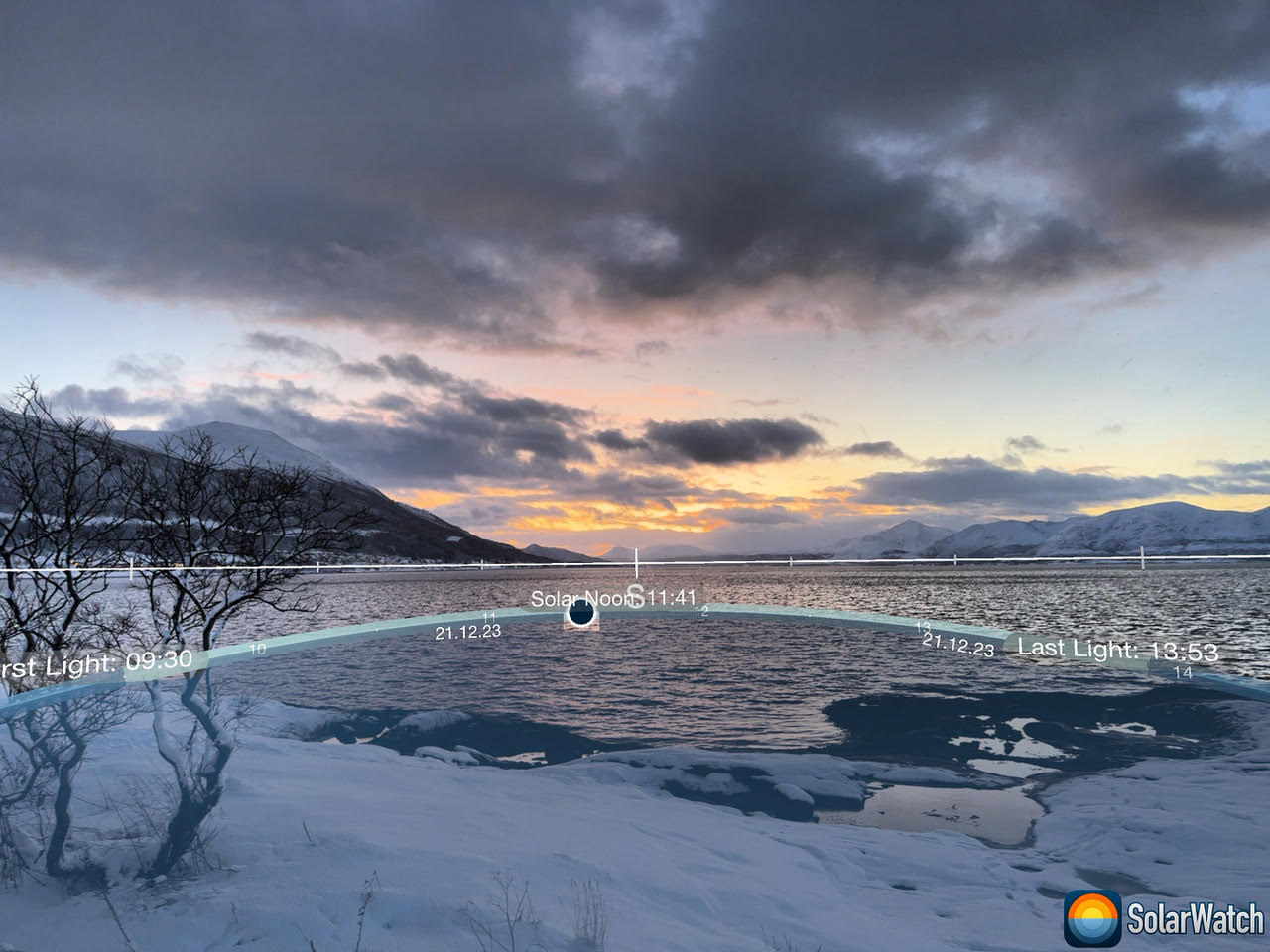
10) XCBabel - So XCBabel is a developer tool for localizing Xcode projects using AI. This is super relevant right now with all the AI stuff happening. What made you want to build a localization tool? Was this a pain point you experienced yourself with existing tools out there?
SolarWatch ships in many languages. Before LLMs, I used DeepL to translate my strings files. It worked but was painfully manual. When Apple introduced String Catalogs, I finally built the tool I’d been wanting: XCBabel. I’ve been using it privately long before releasing it. It scratches my own itch and taught me a lot about SwiftUI on macOS.
11) XCBabel - Developer tools live or die by how well they fit into developers’ workflow. What’s your philosophy on how XCBabel should fit into a developers’s existing process? Do you want it to be invisible, or something they actively engage with?
I experimented with versions that plug directly into builds or run as a fastlane plugin. They’re convenient but take away the ability to review translations. I like that XCBabel has a UI where you can see all languages at once, search, review, and adjust machine translations. A pure CLI would lose that.
I’m also considering a small web service where users can rate translations and suggest fixes. A bunch of web tools do this, but I want one that works the way I want.
12) You’ve been in the iOS community for a long time. How has indie development changed since you started? What advice would you give to someone just getting into indie dev today?
The community is wonderful, full of kind, supportive people. As for being an indie dev, it spans a huge spectrum. Maybe you just want a creative outlet. Maybe you want to build the next Flighty, Widgetsmith, Overcast, CardPointers, Slopes, or Art of Fauna.
The key is not comparing your journey to someone else’s highlight reel. Build something you want to exist. Ship it. Share it. Hand out early TestFlight builds. Push it through App Review. Celebrate the wins. Don’t be crushed if your first app vanishes into the App Store void. Keep going. Decide if you want a business or just a hobby. The learning process is worth it (and sometimes very humbling) either way.
13) What’s been the hardest part of being an indie dev? What’s the most fun part?
The hardest part is getting people to notice your app. Promotion is tough for me. It’s always easier to retreat into code and improve the product. I think a lot of indie devs struggle with this, so maybe it’s my resolution for 2026.
The best part is user feedback. A thoughtful email from a user can make your day. Negative feedback is great too: it means someone cared enough to write. The only truly painful response is silence.
14) What’s next for SolarWatch, XCBabel, or any other projects you’re working on? Anything you can share with us?
SolarWatch is overdue for a design refresh. I’ve heard many times that the main UI is confusing for non-techies, so I’m working on prototypes to address that.
For XCBabel, I want a user feedback system for translations.
The next launch, though, is Readback: an ATC communication training app for pilots. It helps new pilots learn radio basics by talking to an infinitely patient controller, and lets experienced pilots practice. I presented an early version at an AI Tinkerers meetup in Berlin and got so much good feedback that I tore the whole thing apart and rebuilt it. I aim to ship it before the end of the year. Now that I said it publicly, I guess it’s official.
15) Do you have any other indie devs that readers should follow / lookout for?
Hidde and Pol are doing excellent work with Helm. Klemens is on fire with Art of Fauna and Art of Flora. And a shout-out to Gabriel Hauber for being one of the earliest XCBabel users and giving great feedback.
Thank you to everybody who made it to this footer! You either spent the time to read or took the effort to scroll 😊
Make sure to visit https://indiedevmonday.com/subscribe to get an email of future issues!
And go to Twitter and give @IndieDevMonday a follow… or multiple follows if you manage more than one Twitter account 😜